

A historic estate selected as one of the Hyogo Cultural 100
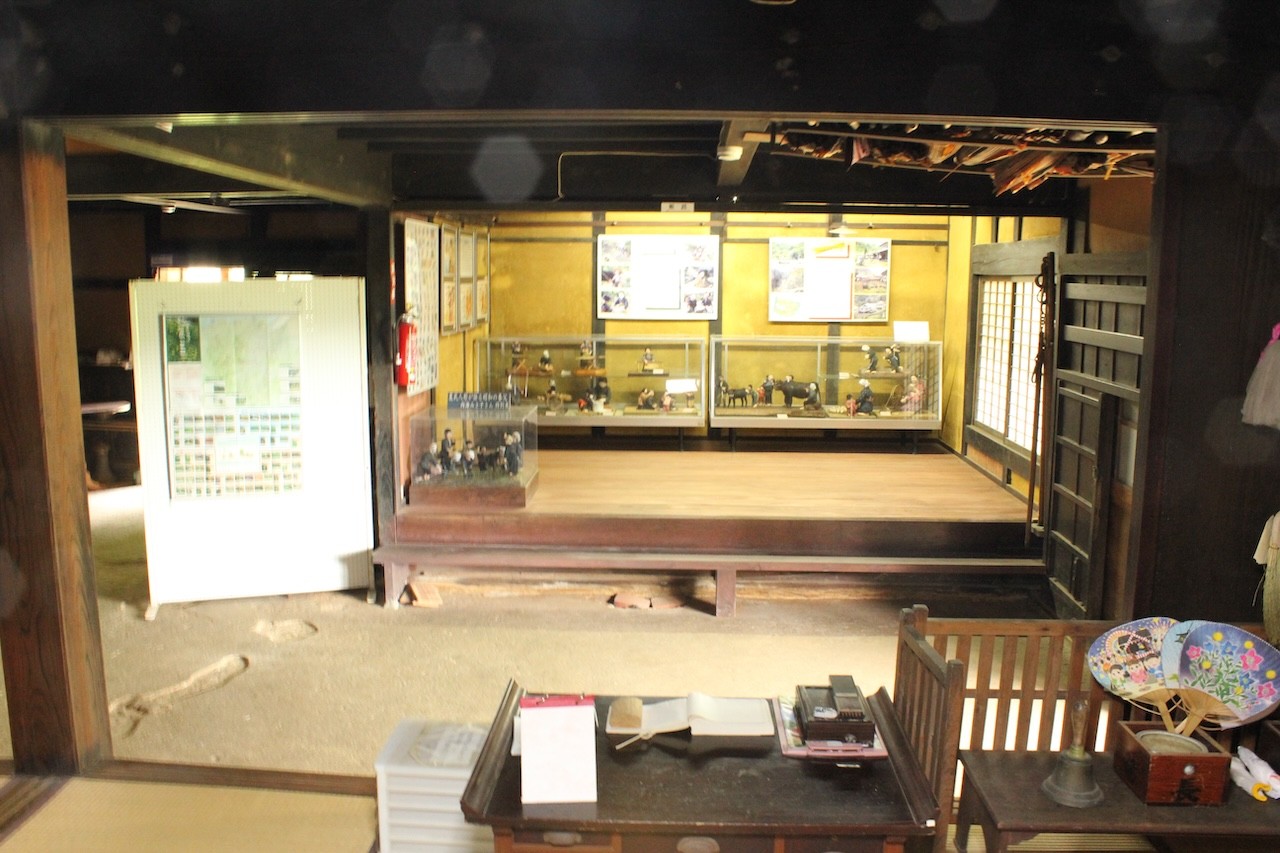
The Yabu City Oshoya Memorial Hall is located on a hill behind the Kojo settlement in Yabu City.
This building preserves the residence of Nagashima Zen’emon, an oshoya (headman) who oversaw 18 villages in the Izushi domain during the late Edo period.
On the first floor of the detached building, there is a sliding-door painting of Taikobo, created by the painter Kobayashi Takusen.
There is also a plaque inscribed with a phrase meaning “fresh colors and the fragrance of spring,” written by Baron Kitagaki Kunimichi, who served as governor of Kyoto.
Behind the annex stands an Oribe stone lantern, said to have been devised by Furuta Oribe and also known as a “Christian lantern.”
The annex, adorned with sliding-door paintings and Chinese poems (kanshi) by Kobayashi Takusen, Kitagaki Kunimichi, Ikeda Soan, Ema Tenko, Tani Tetsuomi, and others, is an impressive space that can truly be called an art museum of rural culture.
This grand residence of a wealthy farming family, surrounded by high stone walls and built on a hill along a mountain stream, represents a typical rural landscape of the Tajima region.
It first opened as the Yabu Town Folk Museum, the Tajima area’s first museum to make use of such a farmhouse residence, and in 2004 it was renamed the Yabu City Oshoya Memorial Hall.
It has been selected by the governor of Hyogo Prefecture as one of the “Hyogo Cultural 100.”